

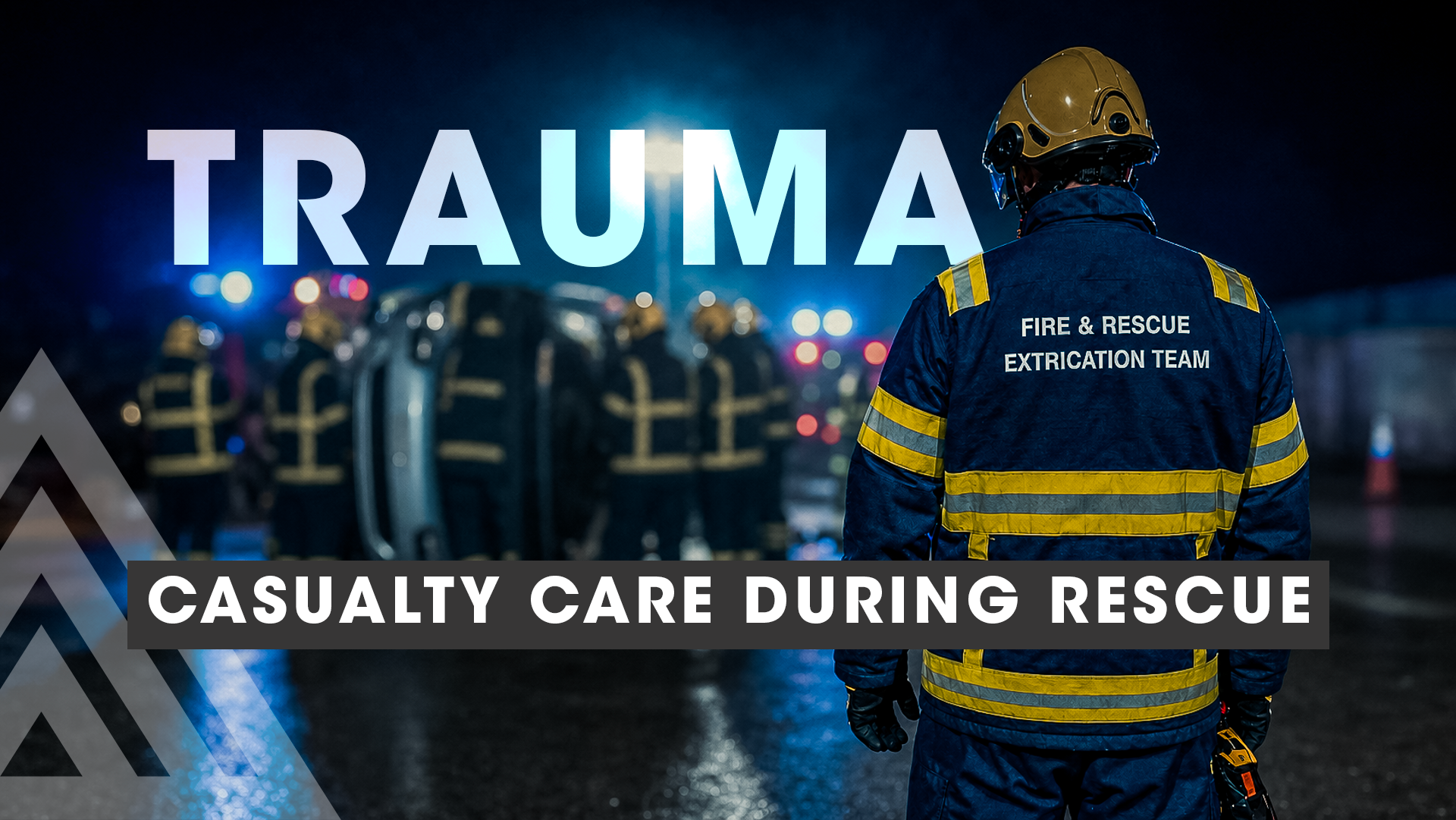
When technical rescue and casualty care happen side by side, a shared understanding of trauma priorities can help fire and ambulance teams work more effectively.

Outreach Insights
Written by Rachel Smith
Clinical Tutor
At a serious road traffic collision, technical rescue and casualty care happen together. While firefighters are creating access and planning extrication, ambulance clinicians are assessing and treating the casualty. The decisions made by each team influence the other.
Firefighters are not expected to become paramedics. However, understanding trauma priorities can help crews support casualty-centred rescue, recognise significant changes and communicate more effectively with ambulance colleagues.
Rescue and Clinical Priorities Go Hand in Hand
The need for role-appropriate trauma education is not new. In 2007, research published in the Emergency Medicine Journal found considerable variation in medical training across UK Fire and Rescue Services and called for a more consistent, competency-based and clinically governed approach.
That need remains relevant today.
The UK Extrication in Trauma (EXIT) project found that casualties trapped following road traffic collisions were more severely injured and had higher mortality than those who were not trapped. They were also more likely to sustain serious head, chest, abdominal, spinal and pelvic injuries.
These findings reinforce an important operational principle: entrapment is not simply a technical rescue challenge. Clinical priorities and rescue priorities often need to be considered together to support timely access to definitive care.
Reflecting this, the Faculty of Pre-Hospital Care’s consensus statement on the management of trapped casualties advocates a patient-centred, time-sensitive approach to extrication, supported by multidisciplinary training and joint learning between Fire and Rescue Services and ambulance services.
Why Trauma Awareness Matters for Firefighters
Understanding trauma priorities does not change a firefighter’s clinical role or responsibilities. It provides context for the decisions being made around the casualty.
A structured understanding of trauma can help firefighters:
- Communicate casualty information more clearly to ambulance clinicians;
- Recognise and report significant changes in a casualty’s condition;
- Understand how clinical priorities may influence rescue decisions;
- Contribute more effectively during prolonged or complex extrications;
- Support realistic multi-agency training and debriefs.
The Faculty of Pre-Hospital Care also recommends regular multidisciplinary learning and case review between Fire and Rescue Services and ambulance trusts. Shared understanding supports better communication, clearer decision-making and more effective joint working.
Where Does PHTLS® for First Responders Fit?
Prehospital Trauma Life Support for First Responders (PHTLS-FR) was developed specifically for firefighters, rescue personnel and other first responders.
Delivered over eight hours, the course introduces a structured approach to trauma assessment through classroom learning, practical skills and realistic casualty simulations. It covers subjects including scene management, patient assessment, airway management, catastrophic bleeding, shock, head and spinal trauma, patient movement and the XABCDE approach to identifying immediate priorities.
The course is designed to complement existing casualty-care training rather than extend a firefighter’s authorised clinical scope.
Like any operational training, its value depends on how it is integrated within a service’s wider approach to competence, clinical governance, operational procedures, equipment and joint working with ambulance partners. Completing a course alone does not create operational capability.
Supporting Organisational Capability
Whether PHTLS-FR is appropriate depends on your service’s operational risks, existing casualty-care capability and training needs.
For Fire and Rescue Services reviewing road traffic collision response, technical rescue or casualty-care development, it provides an established trauma framework that can support multidisciplinary working and casualty-centred rescue.
Outreach Rescue delivers PHTLS® for First Responders for firefighters, rescue personnel and other first responders. Successful participants receive an NAEMT certificate of completion, valid for four years.
If your service is reviewing trauma training or casualty-care capability, contact Outreach Rescue to discuss whether PHTLS®-FR is appropriate for your organisation.